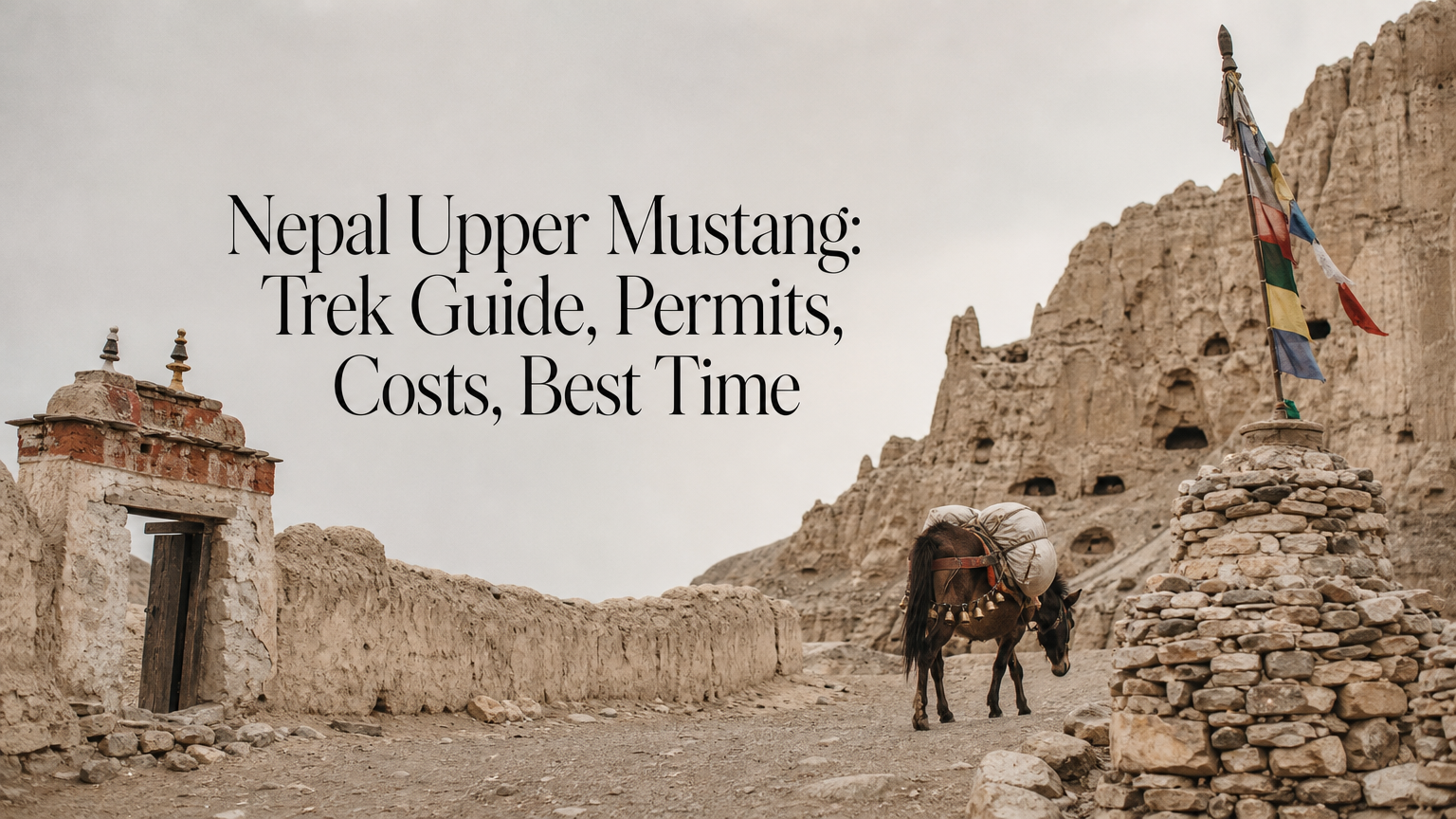
Nepal’s Upper Mustang takes you to a rain shadow region in the northwest of the Annapurna Himalayas. You walk through a dry, wind-carved desert of red cliffs, ancient caves, and whitewashed monasteries. Closed to the foreigner until 1992, and the ancient Tibetan culture of the walled capital, Lo Manthang (The Last Forbidden City), is still preserved and alive. With its unique Himalayan geography, breathtaking landscapes, and ancient cultural heritage, Upper Mustang is a dream destination for trekkers seeking adventure, natural beauty, and an authentic cultural experience.
But how many days are required to complete the Upper Mustang trek? The answer depends on the itinerary, additional destination, type of package, and experience requirement. On average, the Upper Mustang trek takes an average of 10 to 14 days. As the region is located in the restricted area of Nepal, foreigners are required to obtain a Restricted Area Permit (RAP) and other important permits like the Annapurna Conservation Area Permit (ACAP). The cost of a RAP permit for Upper Mustang is USD 50 per day for a trekker, and ACAP costs NPR 3,000 per person. Trekker are also required to trek with a licensed guide.
In this guide, the information about the day-by-day itinerary, permits, total costs, altitude, and the best time for the Upper Mustang trek is provided. We run this trek with our Sherpa guides every season, and we also share honest advice on whether it is worth your time and money.
Why Upper Mustang is worth the trip
The Upper Mustang trek in Nepal is not just about mountains, high altitude, and a desert landscape. Upper Mustang trekking gives you the combination of living culture, unique scenery, and quietness, which is rare. This is the reason we suggest trekkers who have already done Everest or Annapurna take this route.
A living Tibetan kingdom
The walled capital of Lo Manthang is the heart of the trip. Believed to be founded in 1380, it still holds three ancient monasteries (Jampa, Thubchen, and Chhoede), a multi-story royal palace, and 15th-century murals that few visitors ever see. Lo was a Tibetan-style kingdom for centuries, and its last titular king lost his title only when Nepal abolished the monarchy in 2008. You feel the essence of the historical kingdom as you walk the narrow lanes between mud-brick houses.
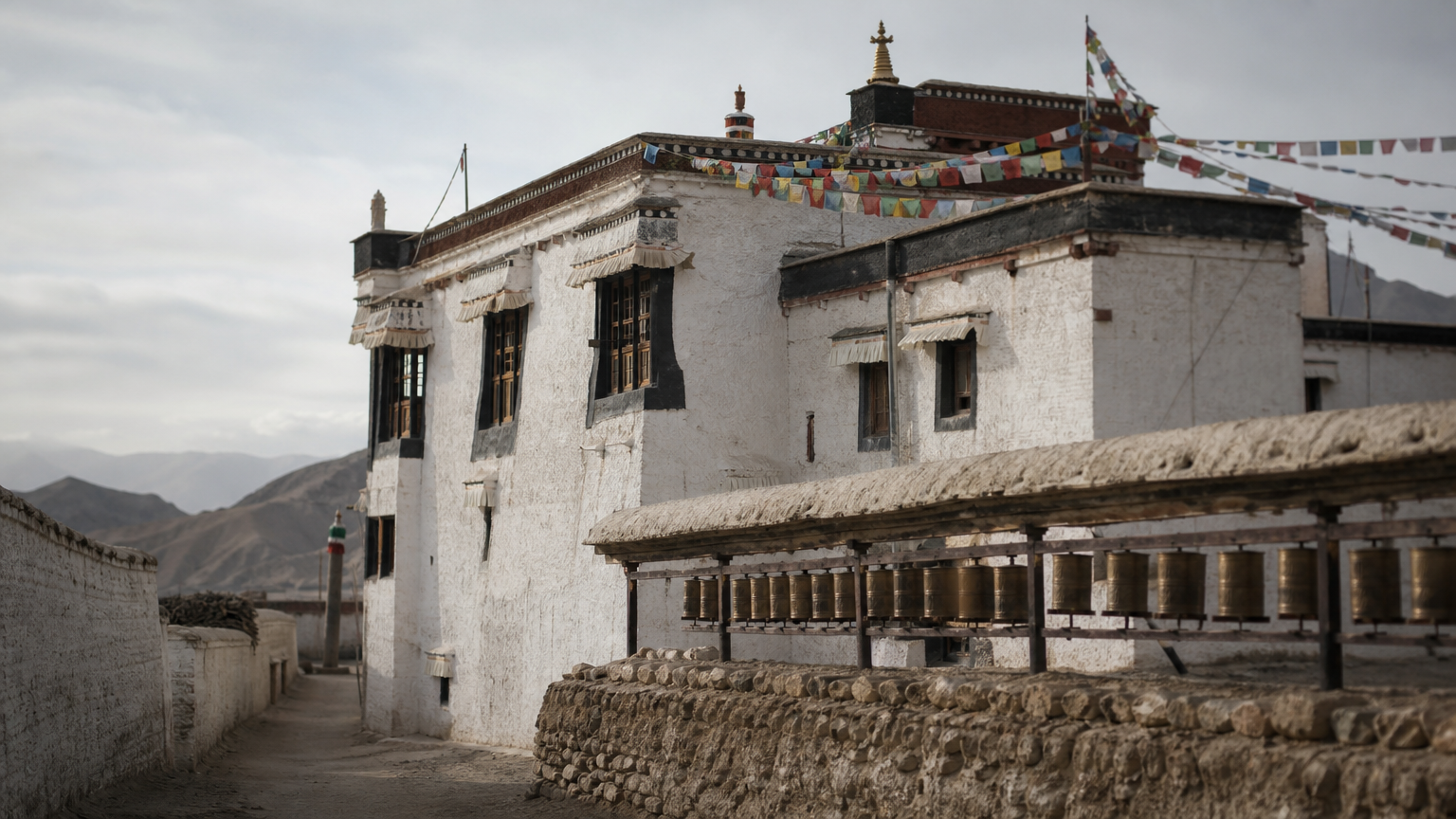
Culture also reaches beyond the capital. You may visit Ghar Gompa (Lo Gekar), one of the oldest monasteries in Nepal, which was built in the 8th century. In spring, Lo Manthang hosts the vibrant Tiji festival, a three-day celebration of masked dances that retell a Buddhist myth. Dates follow the Tibetan lunar calendar, so check them early and book well ahead if you want to be there.
Landscapes unlike the rest of Nepal
During the Upper Mustang trek, you walk through diverse landscapes, from lush green valleys and breathtaking Himalayan foothills to rugged mountain trails and vast, arid desert landscapes. Your trek starts from Lower Mustang at Kagbeni (2,804 m), where apple orchards meet the Kali Gandaki river, then climbs into a high desert of red, ochre, and gray cliffs carved by wind. You walk, leaving Dhaulagiri and Annapurna to rise behind you towards a dry and arid desert landscape. the experience is unique, unlike a trek in other destinations like Everest Base Camp (4,364 m) or Annapurna circuits.
The trek is also full of man-made wonders. Villages sit in canyons, and cliffs are pocked with hundreds of ancient cave dwellings. Some of the noticeable stops that most trekkers or tavelers notice during the trek include:
| Place | What you see | Why it stands out |
|---|---|---|
| Kagbeni (2,804 m) | Gateway to Upper Mustang, apple orchards, checkpoint | Last green oasis before the desert |
| Ghami (3,510 m) | Longest Mani wall of carved prayer stones, traditional loba architecture, Tibetan culture, and heritage | 700-meter-long stone prayer wall, preserved feudal-era layout, and dramatic red cliffs |
| Dhakmar (3,820 m) | Deep red cliffs above the village, hand-carved sky caves. | Best sunset view, beautiful and dramatic village |
| Chhoser (3,850 m) | Multi-level Jhong cave, ancient monasteries (Garphu and Nyiphu) and traditional Tibetan-influenced Lopa culture | Hand-dug dwellings of unknown age |
| Ghar Gompa (3,920 m) | Ancient monastery on a high ridge, Uncommon Nyingma Sanctuary, ancient treasure, and painted stones | World’s Oldest Tibetan Monastery, Linked to Guru Rinpoche (Padmasambhava) |
| Lo Manthang (3,800 m) | Walled capital and royal palace | Tibetan culture intact |
Fewer crowds and a drier climate
The Upper Mustang region gives peaceful experiences and calming atmsphere due to low crowd in comparision to toher popular trails in Nepal. The restricted area permit keeps numbers far below Everest Base Camp or the Annapurna Circuit, so you often share a teahouse with limited trekkers. Villagers still greet you with warm hospitality, welcoming smiles, and century-old customs.
Upper Mustang gives you Himalayan scale and Tibetan culture without the Everest crowds.
The weather of the region is also unique and predictable, as the region sits in the rain shadow region. Monsoon months are also trekkable when most of Nepal experiences heavy rainfall. The altitude of the region is also lower than treks like Everest Base Camp, with the trail staying around 3,000 to 4,000 meters, which suits fit first-timers who acclimatize sensibly.
In addition, the connectivity of the dirt road to Lo Manthang further allows you to share parts of the trail with jeeps and motorbikes. Trekking with a local guide benefits with ideas to avoid challenging conditions, making the trek easier, safer, and more comfortable.
How to plan an Upper Mustang trek
Good planning on this route comes down to three choices: how many days you have, how you reach Jomsom, and who handles your paperwork and permits. Get those right, and the rest falls into place.
Pick your trip length.
Most travelers do trekking in Upper Mustang over 12 to 14 days, counting travel days from Kathmandu. The table compares the common formats.
| Format | Days | Best for |
|---|---|---|
| Walk up and walk back | 12-14 | Side trails, culture, slow acclimatization |
| Walk up, jeep back to Jomsom | 9-11 | Travelers short on time |
| Jeep tour with short walks | 7-8 | Less walking, mixed-ability groups |
Walking both ways takes longer but gives you the best trip. The jeep return is dusty and bumpy, so you can choose it if you have limited time.
Sort out your logistics
Most trips start with Kathmandu to Pokhara, either a 25-minute flight or 6 to 8 hours by road. From Pokhara you fly to Jomsom, then walk or take a jeep to Kagbeni. Flights leave in the morning because afternoon winds in the Kali Gandaki gorge make flight operations challenging.
Delays are common due to road conditions and poor weather in the lower region. Keep one spare day at the end of any Upper Mustang trek, and never book an international flight for the day after you return.
Build a spare day into every Mustang trek, because the Jomsom flight, not your legs, is the thing most likely to delay you.
Restricted area rules require having a guide; however, you can trek in single from March 2026. Demand is highest in May, September, and around Tiji, so book three to six months ahead for those dates.
Checklist before you book
Run through this list before you pay a deposit on any mustang trek in Nepal:
- Passport valid for at least six months, with blank pages for the visa and permit stamps.
- Travel insurance that covers trekking to 4,000 meters and helicopter evacuation.
- Eight weeks of training, with long hikes carrying a daypack and some stair work.
- Flexible dates, with a buffer day on each end.
- A registered agency that arranges permits, a licensed guide, and airport pickup.
That last item is not optional. Since you cannot enter the region on your own, the agency you pick shapes the whole experience.
Upper Mustang permits and entry rules
Entry to this region is controlled by the Nepal government, so you cannot just walk in on your own. The rules are simple once you know them, and a registered agency handles almost all the paperwork. What matters is knowing what you should budget for and carry before you land in Kathmandu.
The permits you need
Two permits cover the trek. Both are checked at Kagbeni, the last village before the restricted zone begins.
| Permit | Cost | Notes |
|---|---|---|
| Upper Mustang restricted area permit | $500 per person for the first 10 days | $50 per day per person |
| Annapurna Conservation Area Permit (ACAP) | About NPR 3,000 (roughly $23) | Needed for the trail from Jomsom to Kagbeni |
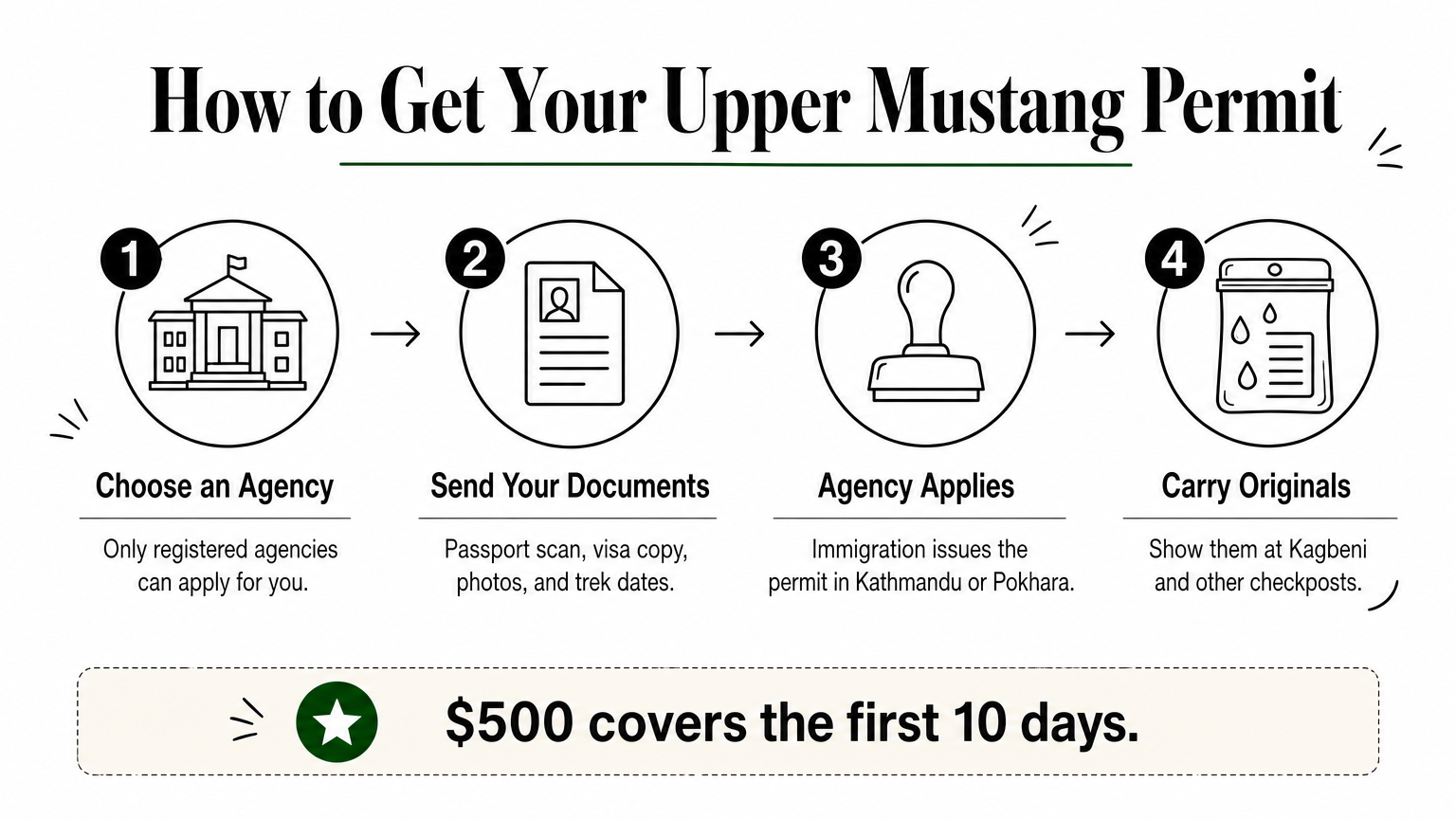
The $500 fee covers 10 days inside the restricted area, counted from the day you cross at Kagbeni. Most itineraries fit that window, but a slow pace or a weather delay can push you over. Ask your agency how extra days are billed before you sign.
How to get your permits
Only a registered trekking agency can apply for the restricted area permit, and it is issued through the Department of Immigration in Kathmandu or Pokhara. Individual travelers cannot buy it at the counter. That is why picking a licensed operator matters more here than on open trails.
You cannot buy the Upper Mustang permit yourself, so your agency and your licensed guide are part of the entry requirement.
Send your agency these items at least a week before you arrive:
- A clear scan of your passport photo page.
- A copy of your Nepal visa, or your arrival date if you plan to buy it at the airport.
- Two passport-size photos, in case a printed copy is needed.
- Your planned trek dates and entry day at Kagbeni.
Rules to follow on the trail
Your permit is personal and tied to your route and your guide. Carry the originals in a waterproof sleeve, because police and army checkposts at Kagbeni and elsewhere will check it. Foreigners cannot cross the Tibetan border beyond Lo Manthang, so the trail ends there.
Finally, fees and local charges have changed in recent years, and some municipalities add their own small entry fees. Confirm current prices in writing with your agency and check the Nepal Tourism Board before you pay a deposit.
Upper Mustang trek cost breakdown
Plan on $2,000 to $3,500 per person for a guided 12 to 14 day trip in Nepal’s Upper Mustang, with permits included. The range depends on group size, hotel standard, additional destinations, and mode of transportation. The restricted area permit alone takes a big share of expenses, so this route costs more than most open-trail treks of the same length.
What a package usually covers
Most trekking agencies include the main trekking expenses in their package prices. Read the inclusion and exclusion in the package closely, because a low headline price often hides extras billed later. The figures below are typical estimates, not fixed rates, so confirm each one in writing.
| Item | Typical cost per person |
|---|---|
| Restricted area permit | USD 500 for 10 days (USD 50 per day) |
| ACAP | About $23 or NPR 3000 |
| Licensed guide and porter | Roughly $35 to $50 per day, usually included in package |
| Pokhara to Jomsom flight | About $100 to $130 one way |
| Teahouse rooms and meals | $25 to $40 per day |
| Airport pickup and ground transport | $50 to $150 |
Costs that sit outside the quote
Some expenses rarely appear in a package price. Set aside about $300 to $500 for these extras so nothing surprises you on the trail:
- Nepal tourist visa, $50 for 30 days.
- Travel insurance with helicopter evacuation cover.
- Kathmandu hotel nights and meals before and after the trek.
- Extra permit days at $50 each if weather delays you.
- Hot showers, battery charging, bottled water, and snacks, usually $2 to $5 each.
- Tips for your guide and porter, commonly 10 to 15 percent of the trip cost.
Ways to keep the price honest
Group size matters the cost of the Upper Mustang Trek. Two to four trekkers split the guide, porter, and any vehicle expenses, so solo departures cost noticeably more per head. Joining a scheduled group is the simplest way to cut the bill without losing quality.
Walking both ways also saves money, since you skip a jeep fare that can run $150 to $300 per vehicle. Be wary of any quote far below the permit total plus flights. That number cannot be right.
The cheapest quote is rarely the cheapest trip, so compare what is included before you compare the price.
Ask each agency for a written breakdown that lists permits, flights, meals, and guide fees separately. If you want a quote built around your dates and budget, our team will send an itemized one with no obligation.
Best time to trek Upper Mustang
The rain shadow location of the region allows the region to be accessed for longer duration in Nepal. May to October is the prime season for Upper Mustang trek .March, April, and November work if you are prepared for cold enviroment. Here is how the year breaks down for a Mustang trek.
Season by season
| Season | Months | What to expect |
|---|---|---|
| Spring | March to May | Clear skies, cold nights, strong afternoon wind. Tiji usually falls in spring, often May. |
| Summer | June to August | Dry and warm on the trail, but cloud delays Jomsom flights. |
| Autumn | September to November | Stable weather and sharp views. Late September and October are busiest. |
| Winter | December to February | Hard cold, snow on the passes, and many Lo Manthang lodges close. |
Daytime temperatures in the villages run roughly 10 to 20°C in the warm months. Nights at 3,800 meters in Lo Manthang still drop near freezing, and the wind in the Kali Gandaki valley picks up after noon in every season. Pack layers whatever month you choose.
The monsoon surprise
Summer is where Upper Mustang beats almost every other route in the country. Everest and Annapurna Circuit trails turn muddy and leech-prone, while Mustang gets only light rain. You also get green fields at Kagbeni, empty teahouses, and lower prices.
The real monsoon risk is getting there. Small planes to Jomsom wait on clear weather, and landslides can block the road from Pokhara for a day or two. Build in two spare days instead of one if you go between June and August.
The monsoon rarely spoils the trail in Mustang, but it often spoils the travel to reach it.
Pick your month by priority
Start with what you care about most, then choose the month that serves it. Our guides usually steer travelers like this:
- Tiji festival: Go in the spring week when the masked dances run, and book three to six months ahead.
- Clearest views and best color: Late September to October, when the air is dry and stable.
- Fewest people and lowest cost: June to August, with flexible flight dates.
- Mild first-timer pick: May or early September.
- Skip it: January and February, unless you want empty lanes and can handle deep cold.
Whichever month you pick, confirm it with your agency before you pay a deposit. The permit clock starts at Kagbeni, so a weather buffer matters more than a perfect date.
Sample Upper Mustang itinerary and route options
The best route is a loop. You walk up the main valley, then come back along the high ridge trails. Below is the plan we use most often for an upper mustang trek nepal departure. Altitudes are approximate, and your guide may adjust the day order for weather or flight changes.
A 13-day plan from Kathmandu
This plan spends 11 days on the ground between Pokhara and Jomsom, with one full rest day in Lo Manthang. Distances are modest, and most days are four to six hours of walking. Wind is the real challenge, so start early and finish before the afternoon gusts.
| Day | Route | Overnight altitude |
|---|---|---|
| 1 | Kathmandu to Pokhara | 820 m |
| 2 | Fly to Jomsom, walk to Kagbeni | 2,810 m |
| 3 | Kagbeni to Chele | 3,050 m |
| 4 | Chele to Syanbochen | 3,475 m |
| 5 | Syanbochen to Ghami | 3,520 m |
| 6 | Ghami to Tsarang | 3,560 m |
| 7 | Tsarang to Lo Manthang | 3,840 m |
| 8 | Rest day, temples and nearby villages | 3,840 m |
| 9 | Lo Manthang to Drakmar via Ghar Gompa | 3,810 m |
| 10 | Drakmar to Chhusang | 2,980 m |
| 11 | Chhusang to Jomsom | 2,720 m |
| 12 | Fly to Pokhara | 820 m |
| 13 | Return to Kathmandu | 1,350 m |
Day 7 is the big payoff, since you cross the Lo La pass at about 3,950 meters and see the walled city appear on the plain. Day 8 is your slack. Use it for the three temples, the royal palace, and a half-day trip to the cliff caves at Chhoser.
Keep the Lo Manthang rest day, because it gives your body time to adapt and gives you time to see the city properly.
Route options to match your time
Not every traveler has two weeks, and not everyone wants the same trail. Each of these variations suits a different goal for trekking in Upper Mustang:
- Shorter version: Walk up as above, then take a jeep from Lo Manthang to Jomsom in one long day. This saves about two days and costs $150 to $300 per vehicle.
- Higher route: Between Ghami and Lo Manthang, your guide can use ridge trails with wide views and far less road dust. Expect a few more steep climbs.
- Muktinath add-on: On the way out, spend a night at Muktinath, a pilgrimage site sacred to Hindus and Buddhists. It adds one day.
- Mustang trek by motorbike: If you prefer a faster, rougher ride, ask us about a guided Upper Mustang motorbike trip instead of walking.
Pick the shape first, then price it. A guide who knows these side trails can show you where the road cuts through and where the old path still runs quiet.
Altitude, difficulty and safety on the trek
How hard the trek really is
The Upper Mustang trek is moderate, and that surprises many people. You walk between roughly 2,800 and 3,950 meters, far below the 5,364 meters of Everest Base Camp. A fit adult who hikes regularly can finish trekking in Upper Mustang without any technical skills.
Daily walks requirs four to six hours with few sustained climbs. The Lo La pass on day 7 is the biggest ascent. What wears you down is the afternoon wind, dust from passing jeeps, and strong sun at altitude. Pack a buff, sunglasses, and SPF 50 sunscreen, and use them from day one.
Altitude and acclimatization
Altitude sickness can hit anyone above 2,500 meters, whatever their fitness. The itinerary above keeps sleeping altitude gains under 500 meters a day, a pace most guides consider safe. Lo Manthang at 3,840 meters is where you will feel it most, so the rest day matters.
These habits cut your risk sharply:
- Drink three to four liters of water a day.
- Skip alcohol on your first nights above 3,000 meters.
- Walk high and sleep low, as on the Ghar Gompa day trip.
- Tell your guide about headaches, nausea, or poor sleep right away.
- Never ride a jeep straight up to Lo Manthang, because it skips the gradual climb.
Mild symptoms mean you rest and hold your altitude. Worsening symptoms, such as a severe headache, vomiting, confusion, or stumbling, mean you go down.
If altitude symptoms get worse, you descend, no exceptions and no negotiating.
Talk to your doctor before you travel about preventive medication such as acetazolamide.
Safety, insurance and evacuation
Remote terrain raises the stakes on any Nepal Upper Mustang trip, so read our Nepal travel safety guidelines first. Lo Manthang has only a basic health post, and mobile signal is patchy outside the main villages. A serious problem means a helicopter evacuation to Pokhara, which can cost thousands of dollars without cover.
Before you book, confirm that your insurance covers trekking to 4,000 meters and airlift. Then ask your agency whether your guide carries a first aid kit and a pulse oximeter, and how they handle emergencies. Beyond altitude, watch for stomach bugs. Eat freshly cooked food, treat all water, and keep your hands clean.
What to pack and what to expect on the trail
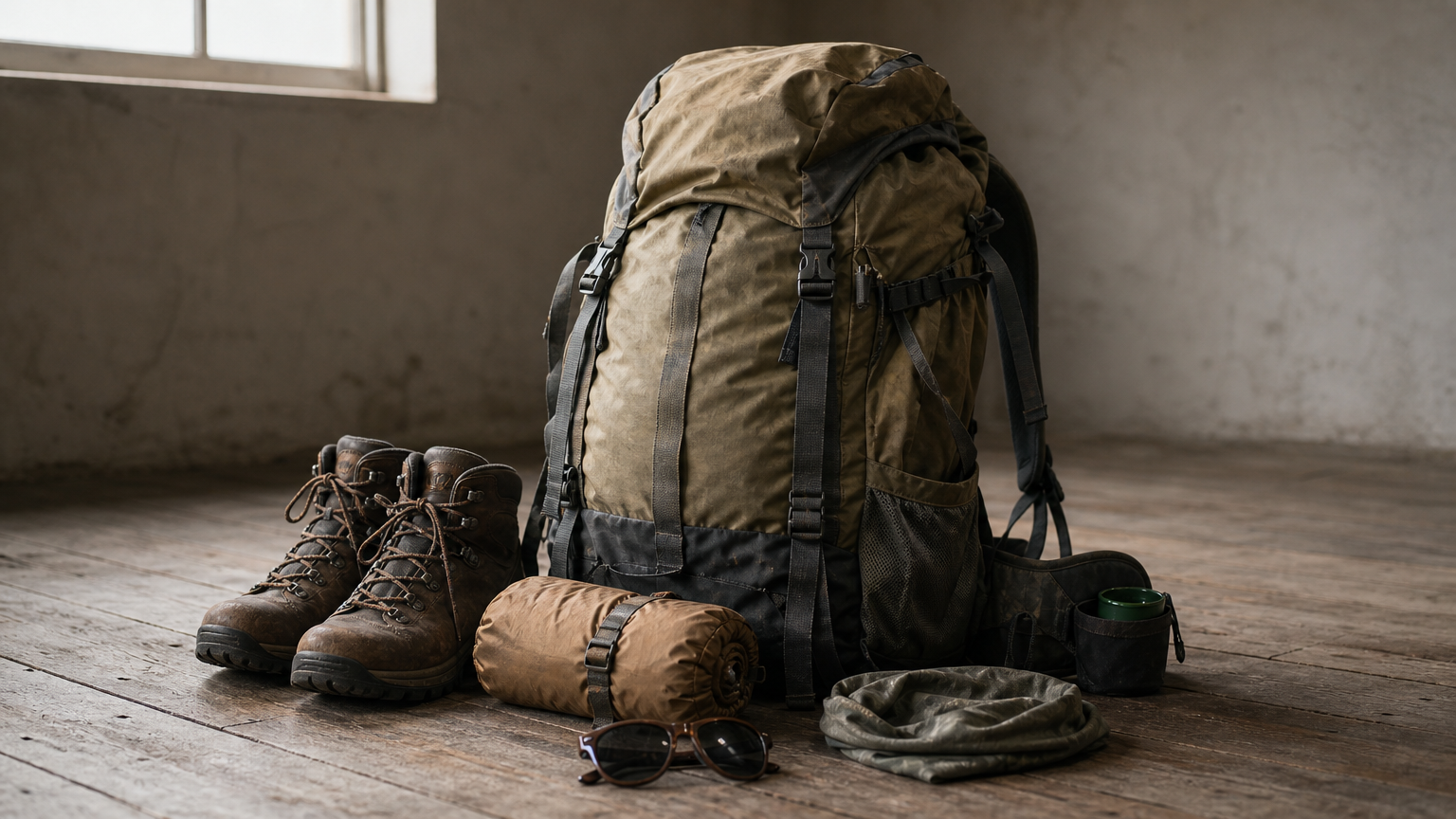
Packing for Nepal Upper Mustang means planning for wind, sun, and cold nights, not deep snow. Pack light and in layers, since your porter carries a shared load and you only carry a daypack. Aim for 12 to 15 kg of total gear per person.
Gear checklist
Rent bulky items in Kathmandu instead of buying them. A down jacket and a sleeping bag rated to -10°C cost a few dollars a day, but broken-in boots are the one thing you should own before you fly.
| Category | Pack this |
|---|---|
| Clothing | Base layers, fleece, windproof shell, trekking pants, warm hat |
| Feet | Broken-in boots, four pairs of wool socks, camp sandals |
| Sun and dust | UV sunglasses, buff, SPF 50 sunscreen, lip balm |
| Sleep | Sleeping bag rated to -10°C, light liner |
| Health | Water purification tablets, blister kit, personal medication |
| Extras | Headlamp, power bank, trekking poles, rupees in small notes |
Dust and wind do more damage here than cold does. Eyes, lips, and throats take a beating by day three, so protect your face first and add extra warmth second.
Wind, sun, and dust cause more trouble in Mustang than cold, so pack protection first and warmth second.
Teahouses, food, and connectivity
Rooms are simple twin beds with shared bathrooms and no heating, so your sleeping bag earns its place. The dining room stove is where everyone gathers in the evening. Expect dal bhat, noodles, momos, and Tibetan bread, with shorter menus than on Everest and more choice in Lo Manthang. Hot showers and charging cost a few dollars each, and Wi-Fi is slow and patchy.
Money needs care. Do not count on ATMs beyond Jomsom, so withdraw enough cash in Pokhara or Kathmandu to cover drinks, snacks, tips, and any extra permit days.
Local customs on the trail
Culture is part of the reason you came, so treat it with respect. Walk clockwise around mani walls, chortens, and prayer wheels, keeping them on your right. Ask before photographing people, and note that many temples in Lo Manthang do not allow photos inside. Your guide will tell you which ones.
Small habits go a long way on any trek in Mustang. Dress modestly in villages, avoid touching religious objects, and buy a tea or snack where you stop. A little courtesy gets you invited into kitchens and monasteries that most visitors never see.
Is Upper Mustang right for you?
Upper Mustang suits you if you want cultural interaction, experience diverse scenery, ancient traditions more than altitude and technical treking routes. You get a living Tibetan kingdom, desert canyons, and quiet trails at a moderate altitude. The trade-offs are clear too. The permit pushes the cost to $2,000 to $3,500, roads share parts of the trail, and the Jomsom flight can delay you.
Skip it if you only want a high pass or a snow-peak view. Choose it if you have 12 to 14 days, decent fitness, and curiosity about a place that stayed closed until 1992. Go between May and October, keep a spare day, and book three to six months ahead for peak dates.
Ready to go? You can plan your Upper Mustang trek with Sherpa Village Trek and get an itemized quote built around your dates and budget.