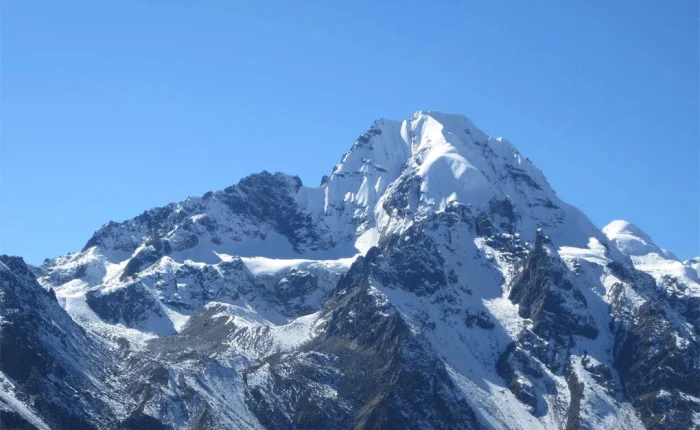


Mera Peak Climbing leads to the summit of Mera Peak (6,476m/21,246ft), which is Nepal’s highest trekking peak. The prime time for ascending Mera Peak is in the spring and autumn when it offers breathtaking views of the Himalayan Vista.
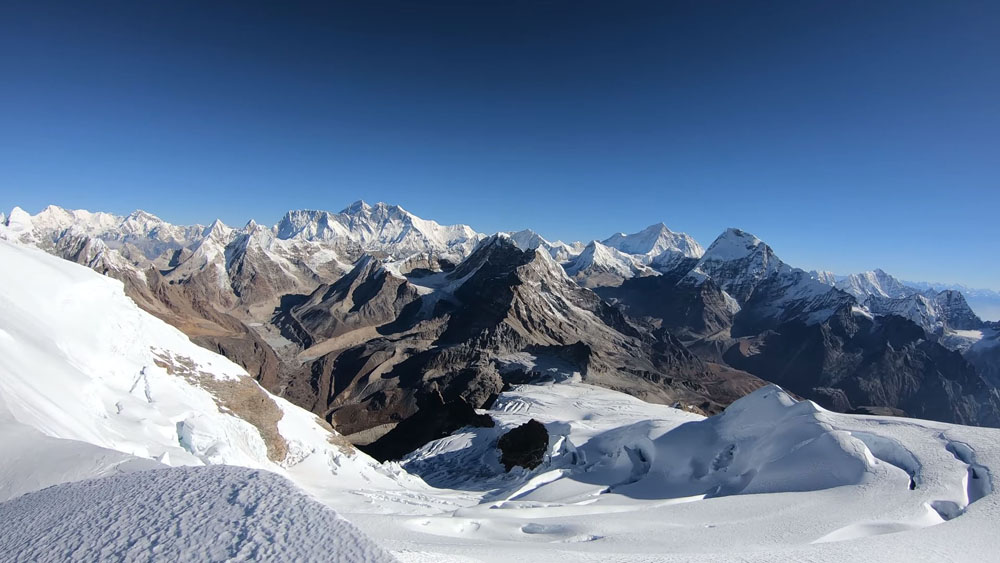
From the top, one can see five 8,000m peaks including Everest, Lhotse, Cho Oyu, Makalu, and Kanchenjunga. The typical route to Mera Peak is through Zatra La Pass; however, we take a different path that goes south from Lukla up Hinku Valley and returns via Zatra La Pass. This route has several advantages as it allows us to traverse picturesque Nepalese wilderness and charming villages while offering insights into local culture. Moreover, due to its longer duration, this route aids in better acclimatization.
Mera Peak climbing provides an appealing option for individuals with moderate mountaineering experience. While it presents challenges due to elevation, the technical mountaineering skills required are quite basic. Additionally, our experienced Sherpa guide will provide fundamental mountaineering training before attempting the actual summit.
Arrival in Kathmandu
Our team will be at the airport terminal to greet you with a name sign upon your arrival. Later in the evening, there will be an orientation session for the trip.
Preparation day
The day is set aside for any final shopping and getting everything ready for the climb and trek. Make sure to review the gear you'll be using, as it's recommended to use all of it in order to make the rest of the climb easier.
Flight to Lukla (2,800m) and trek to Chutanga (3,050m)
After an early morning meal, you will be driven to the domestic Airport in Kathmandu. A 45-minute flight will then take you to Lukla, which is one of the highest Airports and a starting point for Everest. Once in Lukla, we begin our trek towards Chutanga, which takes approximately 4 hours on foot.
Trek to Tuli Kharka (3,900m) via Zatrwa La Pass (4,610m) and trek down to Khartitang (3,900m)
The trail goes over the Kalo Himal Ridge, which divides the Khumbu and Hinku Valley. Further along, we follow a pleasant path that leads to a marked notch on the ridge with prayer flags at 4,450m elevation. Along the way, we might come across yak herders. The views of Karyolung and Lumding Himal from across Dudh Kosi are truly stunning, as well as the panoramic view of the rolling foothills in eastern Hinku Valley. About thirty minutes below the pass is a large boulder where our campsite, Tuli Kharka, is located.
Trek to Kothe (4,095m)
Today, the pathway goes downhill through a rocky trail that leads to a great viewpoint of the Hinku Valley. From here, we can see the beautiful south face of Mera Peak. The path winds its way through forests and then descends steeply into the stunning Hinku Valley. We are treated to breathtaking views of Peak 43 and Kusum Kangguru as we appreciate the natural beauty around us in the Hinku Valley. Walking among pine and rhododendron forests fills us with unique and wonderful emotions. Finally, we arrive at Kothe, where we will be staying for the night.
Trek to Thangnak (4,350m)
After breakfast, we'll begin our walk through the pastures where you might encounter Yak herders. The trek follows the ridge of Hinku Valley, offering breathtaking views of Mera Peak throughout the day - a delightful introduction to your adventure. In Thangnak, there are a few old lodges and guest houses available for accommodation.
Acclimatization Day
During the day, you will make a visit to Sabal Tsho Lake and then embark on an acclimatization hike to reach the cairn at 5,271m on the side of Kusum Kangguru (6,367m). We take two days for complete acclimatization. After resting adequately, we can consider other exciting activities such as leisurely walks around Sabal Tsho, which is a stunning lake formed by moraine, hidden behind the Sabal Glacier. Additionally, there's an option to climb a peak reaching an altitude of almost 5,000m. Exploring Hinku Nup Glacier which extends northward towards Kangtaiga is also possible. The upper Hinku valley veers east at Tangnag and crosses Dig Glaciers' moraine.
Trek to Khara (5,045)
As we leave Tangnag, the path climbs up to a broad grassy basin known as Dig Kharka. We keep trekking for several hours until we reach Khare. Khare has numerous camping spots, with the most well-liked one located at the upper part of Khare below a cluster of boulders. This is where we set up camp. The site provides stunning views of the imposing north face of Mera, Hinku Shar Glacier, and Mera La.
Trek to high camp (5,780m)
Today, following breakfast, we hike through a rocky course to reach the Base Camp of Mera Peak. Upon arrival, we take a short break for lunch before embarking on ice climbing training with our guide. Novice climbers have much to absorb today as well. After approximately 1-2 hours of training, we proceed towards Mera La. Our route to High Camp takes us through Mera La where we rest and appreciate the breathtaking views offered by the area.
Summit Day (6,654m) and return to Khare
In the early hours of the morning, around 2 am and following breakfast, we proceed towards the peak. By sunrise, we can ascend to an altitude of 6,000m or more. After persistent efforts, we ultimately conquer the summit. From this vantage point, you can capture breathtaking views of at least five out of fourteen peaks that measure over 8000 meters in height and also glimpse Mount Everest (8,848m), Cho-Oyu (8,210m), Lhotse (8,516m), Makalu (8,463m), Kangchenjunga (8,586m), Nuptse (7,855m), Chamlang (7,319m), Baruntse (7,129m), Ama Dablam which stands at a lofty elevation of 6,812 meters as well as numerous other majestic peaks measuring over six thousand meters high too.
Upon reaching the summit, we retrace our path back down to reach our higher campsite where we rest briefly with some hot soups/tea before continuing on to Khare for overnight accommodation. This will be a day filled with challenges but one that will undoubtedly inspire us greatly throughout our lives.
Reserve Day
This day serves as a backup in case of unfavorable weather or any other unforeseen circumstances on the planned summit day. If we are unable to summit Mera Peak due to bad weather or other reasons, this spare day allows us to postpone the ascent. It also provides flexibility if someone in the group needs more time to acclimatize. If everything goes according to plan, we won't need this extra day.
Trek to Kothe (3,600m)
After having breakfast today, you will begin your descent from Khare and descend nearly 1,600 meters in altitude until you arrive at Kothe.
Trek to Thuli Kharka
Today's hike includes both uphill and downhill sections. After breakfast in Kothe, you'll begin walking and gradually ascend until you reach Thuli Kharka.
Trek to Lukla
Today marks the final day of your Mera Peak adventure in Nepal. The descent to Lukla via Zatrwa La pass is relatively straightforward. Once you reach Lukla, you will have a closing dinner with all the support staff who accompanied you on this journey.
Flight from Lukla to Kathmandu
You will be boarding an early morning flight to Kathmandu from Lukla. The short 35-minute journey offers stunning views of the Himalayas. Upon arrival in Kathmandu, our representative will drive you to your hotel. You can then spend the rest of the day in Kathmandu as you please. This day also serves as a buffer in case your flight is canceled due to poor weather conditions.
Kathmandu Sightseeing
Today is scheduled as a contingency day in case the flight cannot depart on the planned day due to weather conditions. Upon arrival in Kathmandu, you will have the opportunity to explore and enjoy sightseeing in the city. You'll visit Boudhanath, Monkey Temple, and Durbar Square, all of which are UNESCO World Heritage sites. The intriguing premises of Durbar Square will transport you back to medieval Kathmandu. In the evening, you can experience a cultural dinner program at a Nepalese restaurant.
Departure
Today, a member of our office will transport you to the international terminal at the airport.
Personal Climbing Gear
General
Upper Body
Torso
Lower Body
Hands
Feet
Undergarments
Medical
Other Essentials
Optional
Sherpa Village Trek made my Mera Peak climb an incredible experience! The guides were professional and incredibly knowledgeable, ensuring our safety throughout the trek. The food at the teahouses was surprisingly delicious, and the company’s logistics were flawless. Highly recommended for anyone looking to conquer Mera Peak!
Reaching the summit of Mera Peak was a lifelong dream, and Sherpa Village Trek helped make it a reality. The team was super supportive and encouraging, always pushing me to reach my full potential. They were also very attentive to acclimatization, which is crucial for such a high climb. Couldn’t have asked for a better trekking company!
Everything about my Mera Peak climb with Sherpa Village Trek was top-notch. From the pre-departure briefing to the summit push, they were incredibly organized and professional. The guides were friendly, experienced, and always prioritized our safety. The food was plentiful and tasty, which kept our energy levels high throughout the trek. If you’re looking for a reliable and experienced company to guide you up Mera Peak, look no further than Sherpa Village!