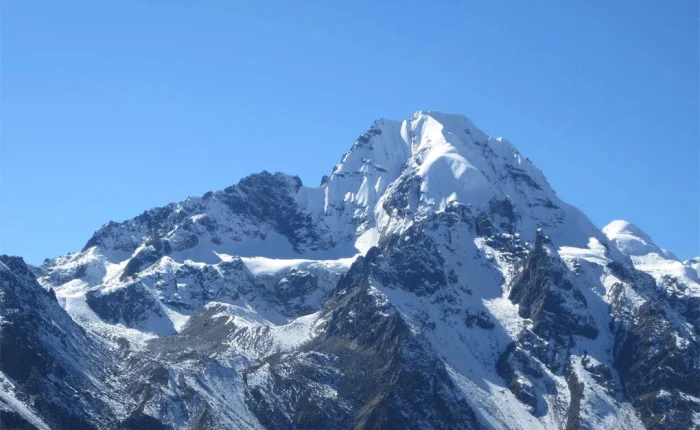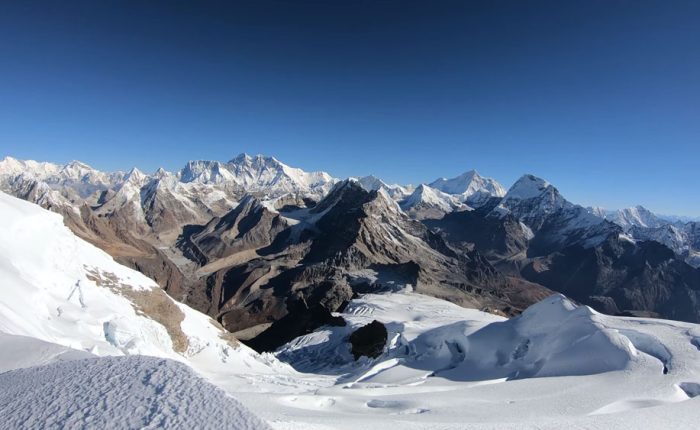


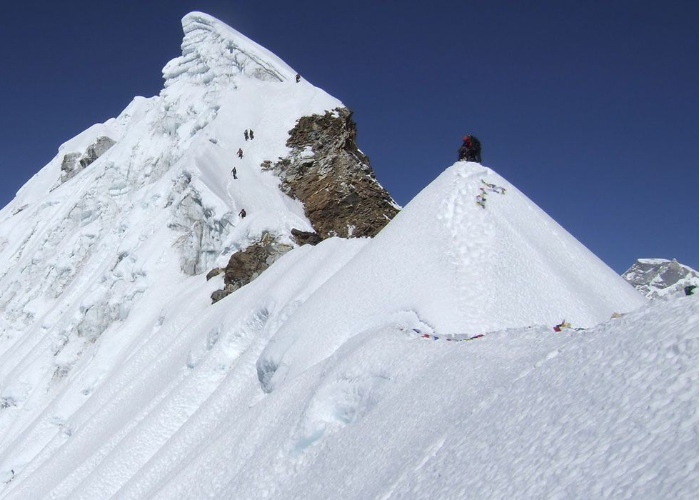
Lobuche East is a well-known peak for climbing in Nepal, situated at an elevation of 6,119 meters within the Everest Khumbu Himalayan range. The summit offers various climbing routes, with the normal route being through South Ridge. It consists of multiple small summits and reaching the true summit involves scaling steep snow and ice slopes from the summit ridge.
Our carefully planned itinerary includes a trek to Everest base camp and Kalapattar before proceeding to Lobuche Peak, allowing ample time for acclimatization.
After returning to Lobuche village from Everest base camp, we will trek up to the Lobuche peak base camp set at 4,950 meters near a lake in a rocky hollow at the base of the glaciated southwest face. The views of Amadablam, Thamserku, Kantega Peak, and Tawache Peak are exceptional from this vantage point. We then ascend steep stone terraces and snow slopes just below the main glaciers on the southwest face of Lobuche East.
Arrival in Kathmandu
Upon your arrival from your home country, you will receive a warm welcome at Tribhuwan International Airport. A staff member will be holding a sign with your name and will escort you to the hotel in a private vehicle. During a brief orientation, you'll have the opportunity to gain valuable insights and meet our guides.
Preparation day
Today, you'll prepare for the upcoming journey. Be sure to pick up any final items you think will be helpful for your trek and take some time to explore the surroundings of your accommodation.
Flight to Lukla and hike to Phadking (2,652m)
Early morning departure from the hotel to the airport for a 25-minute drive, to board a flight to Lukla. The airplane journey is an exciting experience in its own right. Upon arrival at Tensing Hilary Airport, there will time for rest before embarking on a hike to the village of Phadking. Along the trail, hikers will encounter lush green scenery and enjoy views of Kusum Kanguru.
Trek to Namche (3,440m)
Traditionally, Namche Bazaar served as a central point for Tibetan and Solukhumbu traders, facilitating the exchange of salt, meat, textiles, and other essential goods. Today, Namche has evolved into an advanced town with quality bakeries, internet cafes, excellent dining options, and various amenities
Acclimatization Day
Today we will visit Namche Bazaar to gain a deeper understanding of its appearance, local lifestyle, and culture. We'll also have the opportunity to admire the stunning mountain views. This day is dedicated to acclimatizing to the high altitudes before continuing our journey. We will take a hike to the Sherpa Museum and explore cultural artifacts as well.
Trek to Tengboche (3,860m)
The level and uncomplicated path guides you to a vantage point offering a view of Mt. Everest, then continues down into the Dudh Kosi Valley at Pungki Thanka before ascending the right side of the valley to reach Tengboche Monastery (3,860m). This monastery holds great spiritual significance for the Khumbu region. Despite the challenging ascent, hikers are rewarded with panoramic views of Mt. Amadablam, and on clear days, glimpses of Mt. Everest along with its neighboring peaks.
Trek to Dingboche (4,410m)
Descending through stunning woodland, crossing the Imja Khola, and trekking past Pangboche village (3,900m) is likely the most captivating day of the trek. You won't lose altitude like other days and will get to appreciate breathtaking views of Mt. Amadablam, Mt. Lhotse, and more peaks. The trail then leads through meadows to Dingboche, also known as the 'summer valley'.
Acclimatization Day
Today is your second day of getting used to the altitude, and you will spend about 6 hours trekking to reach an elevation of 5,100m. After breakfast, you'll hike up Nagerjun (5,100m), a hill located directly above Dingboche in the Chhukung valley.
The main objective is to climb high and then sleep at a lower altitude. The trail can be quite steep at times, making it a physically demanding day - reaching the top of the hill at this height could take around 5 hours.
From this vantage point, there are impressive views of Lobuche East (6,119m), Lobuche West (6,145m), Taboche Peak (6,367m), Thamserku (6,608m), Kangtega (6,685m), and Ama Dablam from its peak height of 6,856 meters.
On clear days, Makalu - the world's fifth highest peak - may also come into view along with breathtaking vistas of the Pheriche Valley. Following a brief rest stop for some sightseeing, we head back down to Dingboche which takes approximately 2 hours due to elevation changes.
After lunchtime, it’s important to relax as temperatures drop rapidly in the afternoon once sunset approaches over these mountain peaks. You will stay overnight in Dingboche again.
Trek to Lobuche (4,910m)
Walking through a broad valley will lead you to Dughla, where you can visit the Trekkers Aid Post in Pheriche. Here, volunteer doctors from Western countries are present to assist trekkers with support from the Himalayan Rescue Association. Afterward, proceed with your ascent up the valley to reach Lobuche's yak pastures at an elevation of 4,910m.
Trek to Everest Base Camp (5,160m) and back to Gorakshep
Overlooking the Khumbu Glacier following a brief climb through grassy areas. The direct view is of Kalapattar, which offers the best vantage point for observing Mt. Everest's entire southern facade and the surrounding peaks.
After a few hours, we will reach Gorakshep and then proceed to Everest Base Camp. While there isn't much elevation gain, the terrain includes numerous ups and downs that can be tiring in combination with altitude effects - yet this journey is truly rewarding. Approximately 3 hours into the hike, you'll reach Base Camp allowing you to witness the Khumbu Glacier and icefall, where Everest expeditions commence.
Hike to Kalapattar and trek back to Lobuche
Today, we set off early to begin our hike towards Kalapattar. This stunning vantage point provides breathtaking views of the majestic mountains including Pumori, Nuptse, Lhotse, Everest, and the surrounding peaks. After soaking in the beauty for a while, we trek back to Gorakshep where we savor a hot breakfast while admiring the magnificent mountain vistas. Following some rest time, we descended to Lobuche.
Trek to Lobuche Peak High Camp
After having breakfast in Lobuche, we continued our trek to the high camp at Lobuche Peak. Following a brief training and informational sessions, we make our last preparations for summiting Lobuche Peak the following day.
Trek to Lobuche East Peak (6,119m) then back to base camp
Today is the highlight of our adventure, as we set off early to scale Lobuche Peak, weather permitting. The climb typically takes around ten hours and offers breathtaking panoramic views of Everest, Lhotse, Nuptse, Ama Dablam, Tawache, Cholatse, Pumori, and Changri. Following a safe descent from the summit, we will return to base camp on the same day.
Reserve Day
There is no assurance of having ideal weather on our scheduled summit day (day 13), so this day serves as a contingency in case we are unable to reach the top of Lobuche Peak on day 14 due to adverse weather conditions or other factors. If the weather takes a turn for the worse, we may need to delay attempting the peak until today. It can also serve as an opportunity for someone in the group who is struggling to acclimatize properly before making the ascent. This extra day will not be necessary if everything goes according to plan.
Trek to Pangboche (4,000m)
This will be the easiest walk for you. Once you've achieved your dream, you can stroll down to Pangboche.
Trek to Namche Bazaar (3,440m)
Descending from the village of Pangboche, we pass through juniper, rhododendron, Himalayan pine, and fir trees. After crossing the Dudh Koshi River and arriving at Tashinga, we take a break for some tea. We then continued along the trail towards Namche Bazaar.
Trek to Lukla (2,840m)
On the last day of our trek, we returned to Lukla where our journey started. We will have an opportunity to contemplate the trek as a team and acknowledge the individual achievements of all participants. Later in the afternoon, there will be leisure time for exploration, relaxation, or enjoying a refreshing shower. In the evening, we will gather for a farewell dinner and enjoy celebrating with our Sherpa companions through drinks and dancing.
Flight back to Kathmandu
After a 35-minute return flight from Lukla, you will arrive back in Kathmandu. Take in one last view of the Himalayas before heading back. Upon arrival in Kathmandu, our vehicle will take you to your hotel where you can relax for the remainder of the day.
Sightseeing in Kathmandu
The day has been kept as a backup in case the flight is unable to take off on our planned day. Today, you will have the opportunity to take a guided tour of the city and visit locations that are rich in cultural values and traditions. You will see medieval architecture amidst modern concrete buildings at places listed as UNESCO heritage sites such as Durbar Squares, Boudha, Monkey Temple, etc. Additionally, if there's a specific place you'd like to visit, you can choose it too. In the evening, you'll be treated to a traditional Nepalese dinner at one of the local restaurants with cultural performances.
Departure
Packing your bags with memories of the trip, you will take a private vehicle from your hotel parking lot to reach the airport and catch a flight back home to reunite with your loved ones. Our representative will escort you to the airport.
We begin our adventure in Lukla, journeying through the trails of Dudhkoshi surrounded by lush forests of cedar, pine, and rhododendron. We pass through small villages inhabited by the Sherpa community, well-known for their mountain climbing expertise.
Our route takes us to Namche, Tengboche, Dingboche – the base camp of Everest and Kalapatthar offering stunning 360-degree mountain views. Following in the footsteps of Sir Edmund Hillary and Tenzing Norgay Sherpa as they ascended Mount Everest summit.
We immerse ourselves in breathtaking scenery along with experiencing Sherpa culture and lifestyle before reaching the Lobuche Peak base camp.
Personal Climbing Gear
Group Climbing Gear (Provided by us)
Upper Body
Hands
Lower Body
Feet
Sleeping
Travel Bags
Medical
Practical Items
Toiletries Items
Luxury Items
Important Documents
The trip was amazing, with stunning mountains and a visit to the beautiful Gokyo Lake. We also trekked to Everest Base Camp via the Chola Pass. Our guide, Luffy, had excellent knowledge and experience in the Himalayas. Many thanks to Sherpa Village Trek for arranging this fantastic journey.
Sherpa Village Trek arranged our trip to Nepal in November for a group of 23 people. The company efficiently managed all the tour logistics and even provided two partners to accompany us, ensuring everything went smoothly. All aspects of the trip, including the accommodations and transportation, were excellent, making it an enjoyable experience for everyone. We would definitely consider using Sherpa Village again for any future trips to Nepal.
I decided to do the Lobuche peak climb to explore the Khumbu area and get a close look at Mount Everest. The climb was quite challenging, and I had prepared for it in advance. However, facing the summit ridge in person was extremely nerve-wracking. The snow wall near the top was so steep that I could hardly see what lay ahead. Fortunately, Sherpa Village Trek provided amazing support throughout. They made sure my climbing gear was in order and gave me encouraging words to help me through the ascent. If you’re planning any kind of expedition in Nepal, you can certainly rely on the team at Sherpa Village Trek.